


An innovative and robust seismic frame is a key part of a San Francisco office building's sustainable strategy and its bid for LEED Platinum.
CANADA PHARMACY
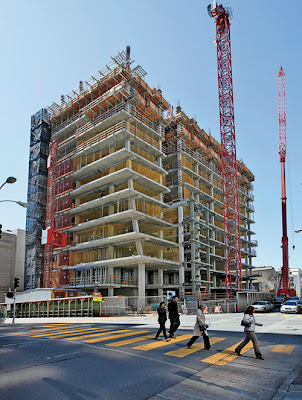
Postponed and nearly derailed several times, the just-topped out concrete structure of the 13-story office building at 525 Golden Gate Avenue, a half block away from San Francisco City Hall, now seems on a smooth path toward completion next summer, more than a decade after the project was first conceived. Twelve years ago, the city acquired the site, which contained a vacant state office building damaged beyond repair by the 1989 Loma Prieta earthquake. The intention was to build a new tower, designed by a joint venture of the San Francisco−based firms Kaplan McLaughlin Diaz (KMD) and Stevens + Associates, for several city departments. But in 2002, with design development for the 277,500-square-foot building well advanced, work stalled in the wake of the dot-com bust.

Then in 2006, the San Francisco Public Utilities Commission (PUC) resuscitated the project with plans to consolidate 1,000 employees from two leased locations. The city already had green goals for the building, targeting a LEED Silver rating. But the PUC, which provides water, wastewater treatment, and power generation services to city and Bay Area customers, had more aggressive goals, asking for a revised design that would achieve LEED Platinum and include on-site renewable power and a wastewater-reclamation system, among other features. But before construction could begin, the project was almost scuttled again when estimates solicited in 2008's heated construction market came in several million dollars over budget.
After a rigorous value-engineering exercise, the now $133 million building is still on target for the higher rating. The tower will use one-third less energy from the grid than a typical office building, saving $118 million in energy costs over the next 75 years, according to Brook Mebrahtu, 525 Golden Gate project manager for the city's Department of Public Works.

To achieve these savings, the building deploys a host of tightly coordinated resource conservation and energy production measures that are almost de rigueur on a green office tower. Except for a swath of Sierra white granite that appears to travel over the roof between the east and west facades, the tower is wrapped in double-glazed, high-performance curtain wall. The building has interior and exterior shading devices for controlling glare and minimizing heat gain, light shelves for daylight harvesting, an under-floor air-distribution system, and a 200 kW roof-mounted photovoltaic (PV) array expected to supply about 7 percent of the facility's electricity.
The building also incorporates a few technologies that are still considered a bit exotic. For example, the tower will have a "living machine."
It includes a man-made wetland that will serve as an ornamental feature at the perimeter of the lobby. By mimicking natural processes and relying on plants and other beneficial organisms, the system will cleanse the gray and blackwater generated by the tower, making it suitable for uses such as toilet and urinal flushing. The PUC also hopes to use the reclaimed water for irrigation, but San Francisco does not yet have a permitting process for such systems. According to Mebrahtu, the state and city departments of public health are currently reviewing the relevant regulations.
Another unusual element of 525 Golden Gate is building-integrated wind technology. Six to eight vertical axis turbines, of about 1 kW each, will be mounted on a stair tower on the north facade, taking advantage of a steady wind from the north-northwest. Although they are expected to generate less than 1 percent of the electricity consumed by the building, the PUC will have the option of swapping the turbines out for more efficient ones when the still-nascent building-integrated wind technology improves. In addition, the rotating turbines will serve an important function as a visible source of renewable power, points out Todd Ravenscroft, an associate and project manager in the San Francisco office of Arup, which developed the building's mechanical engineering concept. "You won't be able to see the PVs making energy," he says


The turbines and the wastewater-reclamation system are on the leading edge. However, they are not the building's most unusual sustainable elements. Arguably, it is the structural frame, described as "self-healing" by the project's Berkeley-based seismic consultants, Tipping Mar. After a design basis earthquake (DBE) - a major temblor calculated to have a return period of about 475 years - the tower should remain undamaged and safe for employees to occupy immediately. And after a much more powerful and statistically less likely event - a maximumcredible earthquake (MCE) - one with a 2,475-year return period - the building should suffer negligible damage. A MCE is the most severe earthquake that can be expected to occur at a given site on the basis of geologic and seismologic evidence. But following such an event, the PUC building should need repair only to the skin or other architectural elements.

The LEED rating system contains no credits that pertain to seismic design. Nevertheless, the PUC team members regard the structural frame as one of the building's primary green attributes. They hope that this durability will earn the project points for innovation. "Resilience is one of the fundamental design goals," says David Mar, Tipping Mar principal. "It is deeply coupled with the client's notion of sustainability."
The structural system includes what is sometimes referred to as a "rocking mechanism" because its
elements are designed to return to their original position after an earthquake's shaking. It relies on post-tensioned concrete slabs and two vertically post-tensioned concrete cores. The tensioned tendons, housed unbonded inside ducts placed between the rebar, provide a restoring force, closing cracks that will develop in the concrete during a quake, explains Mar.

Initially, plans for the PUC building called for a steel structure - one with the same column grid and core locations - but with a special-moment frame that included viscous dampers. Like the post-tensioned concrete building under construction now, the steel version was designed to allow the agency's staff to maintain continuous operations after a DBE. But during a more extreme event, the concrete frame should perform better, especially in the area of internal acceleration, says Mar. For example, his team studied the ability of the two sytems to protect mechanical equipment secured with standard bracing. They found that the concrete scheme was able to withstand higher accelerations.
Curiously, this level of performance was not the primary motivation for the substitution in structural systems. Instead, the main impetus was the need to cut costs. The moved shaved about $10 million from the construction price, with about half of those savings attributed to the associated elimination of architectural elements, such as fireproofing and finishes, including suspended ceilings. This approach meant that much of the poured-in-place structure would be left exposed, a look that the PUC apparently had no objections to. "You need a client who is able to accept that aesthetic," points out David Hobstetter, KMD principal.

One bonus of the redesigned structural system was that it permitted the team to reduce the floor-to-floor height by a foot and insert an additional office level within the same zoning envelope. But it also provides other synergistic advantages - for the daylighting scheme in particular. The new concrete structure eliminates the sunlight-blocking deep perimeter beams that were a key part of the special moment frame solution. In addition, the new frame allowed designers to taper the underside of floor slabs toward the curtain wall to help bounce the sun's rays from light shelves to the ceiling, and then into the interior of the largely open office floors.
Photo cells control indirect lighting, dimming fixtures when daylight levels are sufficient. To make sure the ceiling's color would be compatible with this illumination strategy, designers set a minimum reflectivity for the concrete in the project's specifications - an unusual request for poured-in-place construction. "We received a lot of RFIs," says Hobstetter.
The PUC has a raised floor for managing data infrastructure and for distributing conditioned air. The system was also included in the steel-framed version of the building, but the cavity provides an added benefit now that the structure is made of concrete. The structure's mass should act like a thermal battery, storing heat generated by people, equipment, and lighting during the day. At night, facility managers should be able to purge this heat by drawing cool outdoor air through the under-floor cavity, helping reduce load on the building's chillers. Unfortunately, because of the limitations of analysis software, engineers weren't able to fully exploit the heat-storing capacity of the structure in their design so that they could, for example, make mechanical equipment smaller. "Modeling tools don't quantify the contribution of thermal mass well," says Ravenscroft. "But we believe there is some benefit."
While the project team tried to make the most of any synergies between the frame and the other building systems, at the same time they worked to reduce the embodied energy typically associated with a concrete structure. To minimize its carbon footprint, engineers have substituted about 70 percent of the Portland cement in a standard concrete mix with supplemental cementitious materials (SCMs), including slag (a byproduct of steelmaking) and fly ash (a byproduct of energy generation from coal-fired power plants). By replacing a material that is energy-intensive to manufacture with waste products that might otherwise have be sent to landfills, team members say that they have cut the carbon emissions of the PUC's concrete in half.

The unusual mix has not been without its challenges, especially for the general contractor, Webcor Builders. Although it already had experience with cement replacement, the PUC structure called for a much higher proportions of SCMs than any of the company's earlier projects. With such a high level of substitution, "the products begin to significantly change the dynamics of hydration," says Matt Rossie, Webcor's project director, referring to the chemical reaction that allows concrete to set and harden when cement is combined with water. In general, SCMs like slag and fly ash slow the process, but understanding just how much is critical to estimating how quickly a particular mixture will gain strength, which in turn is important to both the quality of the finished product and the construction schedule.
To help determine how soon formwork can be stripped and when post-tensioning can be applied Webcor and its subcontractor, San Jose−based Central Concrete Supply, are relying on a process known as "maturity testing." The method involves monitoring the heat generated as a result of hydration with embedded sensors and then correlating those results to laboratory tests for the same mix. "Early strength gain is just a function of temperature and time," explains Mike Donovan, Central's manager of technical services.
Relying on this testing method, contractors have been removing forms from the columns about 24 hours after concrete placement and tensioning the horizontal tendons around three days after each slab pour. At press time in mid-May, the frame was almost complete, with only the tensioning of the core tendons remaining. With all the projects' fits and starts, the contractor is relieved to have reached this milestone. Says Rossie, "It's extremely satisfying to see the structural system come to fruition."


